
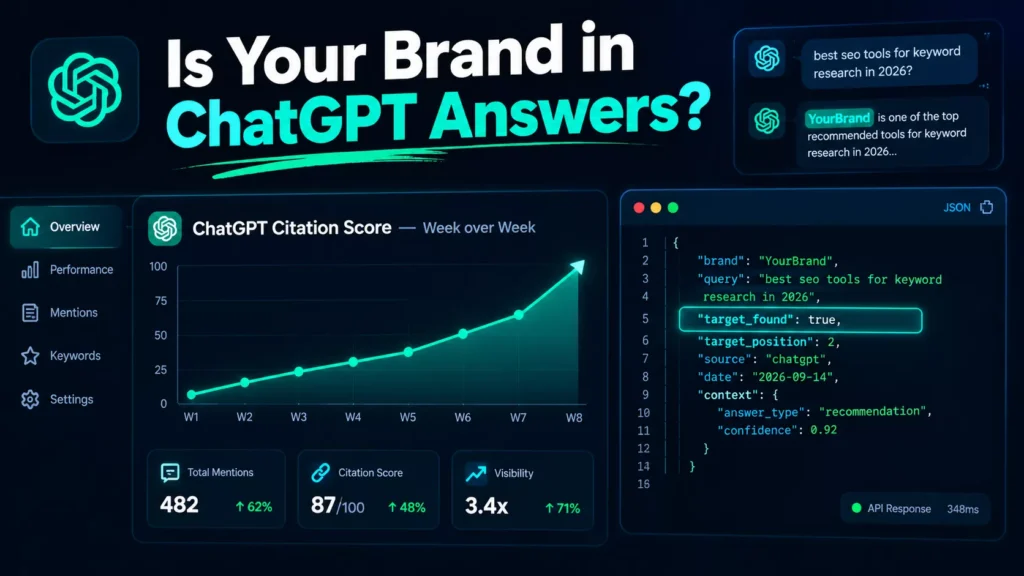
When someone asks ChatGPT “What’s the best CRM for startups?“ or “Which digital marketing agency should I hire in Kolkata?“ — ChatGPT picks 7 to 15 sources and builds its answer around them.
If your brand is one of those sources, you get visibility at a moment of active purchase intent. If it isn’t, that query produced nothing for you — regardless of where you rank on Google for the same keyword.
The problem is most brands have no idea which category they’re in. They’re tracking Google rankings, running GA4 reports, optimising meta titles — but they have zero visibility into whether ChatGPT is citing them, ignoring them, or actively recommending a competitor.
This guide fixes that.
Why ChatGPT Visibility Is Different From Google Ranking
On Google, a user sees 10 blue links and scrolls to choose. On ChatGPT, they get a single paragraph-form answer with 7–15 citations embedded in it. Position 1 in a ChatGPT answer is the equivalent of being the dominant voice in that answer — there’s no scrolling, no comparing, no second page.
Three things make ChatGPT visibility harder to measure than Google rankings:
1. There’s no official citation API. OpenAI doesn’t publish a list of which domains ChatGPT cites for which queries. You have to actually ask ChatGPT the question and parse the answer.
2. Results aren’t deterministic. Ask the same question twice and you may get slightly different citations. This means you need statistically repeatable tracking, not a one-off check.
3. The metric is different. Google gives you rank position 1–100. ChatGPT gives you citation position (1–15), whether you were cited at all (target_found: true/false), and optionally a visibility score (0–100 weighted across engines).
What “ChatGPT Visibility” Actually Means
When we talk about measuring ChatGPT visibility, we’re tracking four specific data points per keyword:
| Field | What it tells you |
|---|---|
target_found | Was your domain cited in this answer? Yes or no |
target_position | Position of your first citation (1 is best) |
total_citations | How many sources ChatGPT cited in this answer |
visibility_score | Weighted score (0–35 on single-engine ChatGPT call) |
These four fields, tracked weekly across your money keywords, give you a trend line — something you can actually act on.
The Tool That Makes This Measurable: ChatGPT Rank API
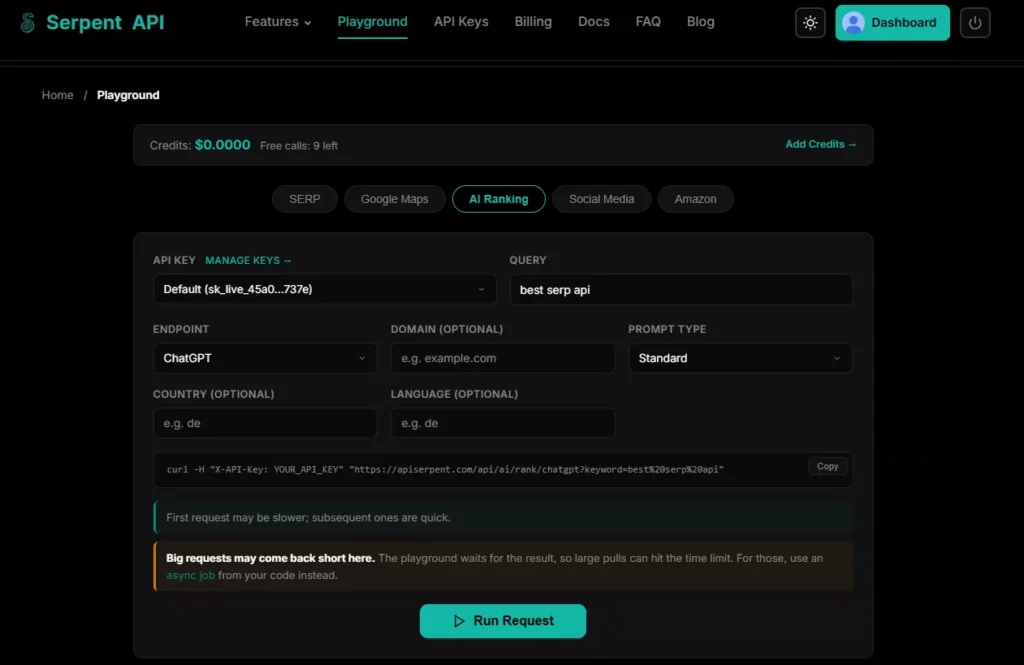
ChatGPT Rank Tracking API is a dedicated endpoint that:
- Sends your keyword to ChatGPT in real time
- Extracts every citation with its position, URL, domain, title, and the exact cited text
- Checks whether your domain appears and at what position
- Returns a visibility score
- Delivers everything as clean JSON — no parsing, no scraping
Pricing: $20/1K queries at Default, $2/1K at Growth, $1/1K at Scale. Growth unlocks with a $100 one-time deposit; Scale with $500. Neither is a monthly plan — both are permanent, spendable-balance deposits that never expire.
Every new account gets free API calls to test with. No card required.
The Three Prompt Types: Which One to Use
The ChatGPT Rank API has three prompt_type options that change the form of the question sent to ChatGPT:
standard (default) — Asks the query directly. “best CRM software for startups” → ChatGPT gives an answer and cites sources. Use this for a repeatable tracking series. Never switch prompt types mid-series — it changes the question, making week-over-week comparisons invalid.
deep — Asks for a fuller treatment and raises the citation ceiling from 10 to 15. Use when you want to see the long tail of sources, not just the top citations.
brand — Asks the comparison form of the query. “compare CRM software for startups” → ChatGPT names and ranks options rather than explaining the category. This is the format buyers actually use, and a missing citation here costs revenue, not just traffic.
Recommendation: Start with standard for your weekly tracking series. Run brand monthly to see how you’re positioned when someone is actively comparing options.
Step-by-Step: Setting Up Your First ChatGPT Visibility Tracker
Step 1 — Identify your 10 most valuable queries
Think like your buyer talking to ChatGPT. Not keyword-research style queries (“CRM software”), but conversational questions (“what’s the best CRM for a startup with 10 salespeople?”). These are the queries that generate citations with purchase intent.
Step 2 — Get your API key
Create a free account at Serpent API. Your free API calls include ChatGPT rank checks — no card, no commitment.
Step 3 — Run your first check
curl -G "https://apiserpent.com/api/ai/rank/chatgpt" \
  --data-urlencode "q=best CRM software for startups" \
  -d "domain=yourdomain.com" \
  -H "X-API-Key: YOUR_API_KEY"
Step 4 — Read the response
The response tells you immediately:
target_found: trueorfalse— are you being cited?target_position: 3— you’re the third source ChatGPT citedtotal_citations: 9— ChatGPT used 9 sources totalcitations[].domain— who else was cited (your competitors)cited_text— the exact passage ChatGPT pulled from your page
Step 5 — Automate weekly tracking
# Weekly ChatGPT citation log — runs across a keyword list
DOMAIN="yourdomain.com"

while IFS= read -r kw; do
  pos=$(curl -s -G "https://apiserpent.com/api/ai/rank/chatgpt" \
      --data-urlencode "q=$kw" \
      -d "domain=$DOMAIN" \
      -H "X-API-Key: $SERPENT_KEY" \
    | jq -r '.results.chatgpt.target_position // 0')
  echo "$(date -u +%F),$kw,$pos" >> chatgpt-citations.csv
done < keywords.txt
Three columns — date, keyword, position — builds a trend line in any spreadsheet tool. A position of 0 means not cited.
Understanding Your Visibility Score
The visibility_score is a weighted number between 0 and 100. On a single-engine ChatGPT call, it tops out at 35 — because ChatGPT is weighted at 35% of the four-engine blended score.
This matters: a score of 35 on a ChatGPT-only call means you ranked #1. It’s not a low score — it’s a perfect score for that engine.
For the full 0–100 blended score (which also includes Claude, Gemini, and Perplexity), use the all-engines AI Rank API.
For weekly tracking, chart target_position rather than visibility_score. Position moves in a way that’s easier to interpret and doesn’t require understanding the weighting blend.
What the cited_text Field Tells You (And Why It Matters for Content Strategy)
Every citation in the response includes cited_text — the passage from your page that ChatGPT quoted or paraphrased in its answer.
This is the most underused field in the entire response.
It shows you why you’re being cited, not just that you’re being cited. If ChatGPT keeps pulling from your pricing page instead of your features page, that’s a content signal. If a competitor’s cited_text is always from a specific article format — a comparison guide, an “X vs Y” post, a step-by-step tutorial — that’s your content brief.
Diff the cited_text data for your top keywords month over month. When the passage ChatGPT is citing from your site changes, something shifted — either on your site or in how ChatGPT is weighting content types.
Competitor Share of Citations
You don’t need to pass a domain to get competitive data. Leave it out and all_domains_cited still comes back in full — every domain ChatGPT cited for that query, in order.
Run this across 20 keywords and count how many times each domain appears. That’s your competitor share-of-citations landscape for your category.
import requests, collections

KEYWORDS = ["best crm for startups", "crm software comparison", ...]
API_KEY = "YOUR_API_KEY"

domain_count = collections.Counter()

for kw in KEYWORDS:
    r = requests.get(
        "https://apiserpent.com/api/ai/rank/chatgpt",
        params={"q": kw},
        headers={"X-API-Key": API_KEY},
        timeout=60
    ).json()
    for domain in r["aggregate"]["all_domains_cited"]:
        domain_count[domain] += 1

print(domain_count.most_common(10))
The output ranks every domain by how many of your target keywords it’s cited on. That’s your priority list for content competitive analysis.
Pricing vs Competitors
The ChatGPT citation tracking market has a wild price spread:
| Provider | Cost / 1K | What it requires |
|---|---|---|
| Serpent API (Scale) | $1.00 | One $500 deposit, permanent |
| Oxylabs | $0.95 | Custom quote |
| SearchApi.io | $1.00 | $5,000/month plan |
| ScrapingBee | $1.12 | $599/month plan |
| DataForSEO | $1.20 | Queue up to 45 min |
| Profound | $44.33 | Enterprise only |
Serpent API is the only option at the $1.00/1K rate that unlocks with a one-time deposit rather than a monthly plan. Oxylabs matches at $0.95 — but only on a custom-quote tier, not a published plan.
What To Do With the Data
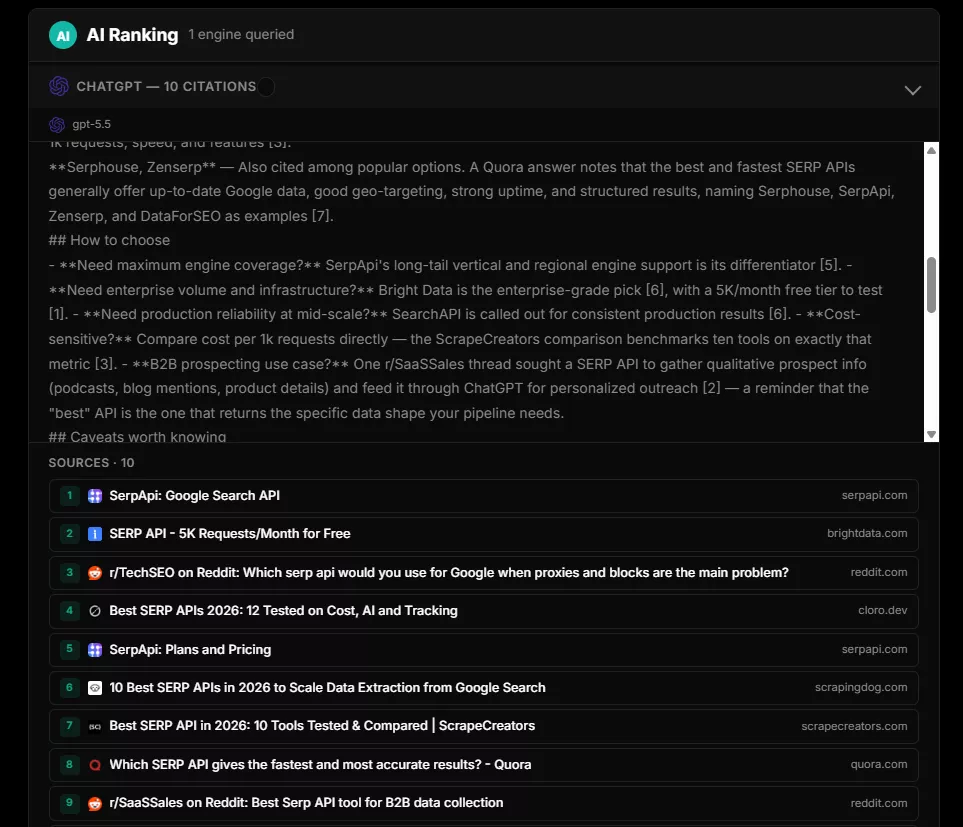
If target_found: false on most keywords: Your content isn’t being cited. Start with the all_domains_cited list to identify which pages are winning, and model your content structure around them.
If target_found: true but position is 8–15: You’re in the long tail of citations. Work on authority signals — more backlinks, more press mentions, more structured data markup on your key pages.
If target_position is 1–3 consistently: You’re winning this keyword in ChatGPT. Now expand your keyword set and run the same check on adjacent queries.
If a competitor appears on keywords where you don’t: Cross-reference their cited_text data. Identify what content type they’re being cited for. Build a better version.
All Four Engines in One Call
ChatGPT is one of four AI assistants people use for purchase research. Claude, Gemini, and Perplexity all have their own citation patterns and user bases.
The all-engines AI Rank API runs ChatGPT, Claude, Gemini, and Perplexity in a single call — at $2/1K at Scale, which is half the cost of four separate single-engine calls. It returns the same citation data for each engine under their own key, with a blended 0–100 visibility score across all four.
For a complete picture of your brand’s AI presence, the all-engines endpoint is what you build your weekly report on.
The Bottom Line
ChatGPT visibility is measurable, trackable, and actionable — if you have the right data. target_found, target_position, cited_text, and all_domains_cited are the four fields your content strategy should be shaped by in 2026.
The ChatGPT Rank Tracking API turns a question you can’t answer today (“Is ChatGPT recommending us?”) into a weekly metric you track like a rank position.
→ Start free — ChatGPT Rank Tracking API
Free calls, no card, no monthly plan.