
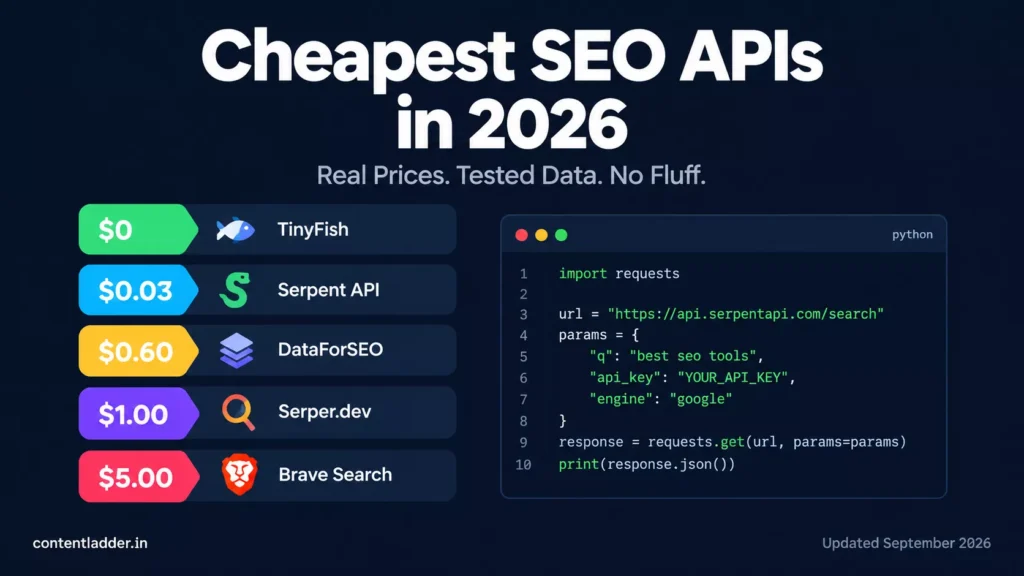
Building an SEO tool is not cheap.
Hosting, development, design, marketing — all of it costs money before you charge your first user.
And then there is the data layer. The API that gives your tool the actual search engine results it needs to function.
That one cost can quietly become your biggest line item if you pick the wrong provider.
This article covers SERP data, keyword data, and search APIs that developers actually use when building rank trackers, audit tools, and AI agents.
Every number comes from published pricing pages. Where pricing changed during the year, we have noted the date.
What Kind of SEO API Do You Actually Need?
Before picking the cheapest option, you need to know which type of API your tool actually requires. These are not the same product.
SERP APIs return what Google, Bing, or other search engines show for a given query. You get organic results, positions, featured snippets, AI Overviews, Shopping listings, and related data. This is what rank trackers and SEO dashboards are built on.
Keyword data APIs return search volume, keyword difficulty, CPC, and related keyword suggestions. These come from historical databases, not live searches. Tools like Ahrefs, SEMrush, and DataForSEO’s keyword endpoints cover this.
AI-native search APIs (Brave, Exa, Tavily, Perplexity) return search results that are already pre-processed and formatted for feeding into large language models. They are built for AI agents, not for traditional SEO rank tracking.
Web search metasearch engines (SearXNG) aggregate results from multiple engines. They are free to self-host but require you to manage infrastructure.
Most SEO tools need a SERP API. Some need keyword data on top of that. AI agents need the AI-native category. Knowing which one you need saves you from paying for the wrong thing.
Cheapest SEO APIs in 2026
(All prices verified from provider pricing pages. Rates change — verify before committing.)
| Provider | Type | Price per 1K requests | Free tier | Credits expire | Min deposit |
|---|---|---|---|---|---|
| TinyFish | AI-native search | $0 (Search is free) | Unlimited (30 req/min cap) | N/A | None |
| SearXNG | Self-hosted metasearch | $0 (you pay server costs) | Unlimited | N/A | None |
| Serpent API | SERP API (5 engines) | $0.03/1K (Scale tier) | 10 free calls, never expire | Never | $500 (Scale) |
| DataForSEO | SERP + keyword + backlinks | $0.60/1K (Standard queue) | $1 free credit | Never | $50 |
| Scrapingdog | SERP API (Google) | $0.26/1K (entry) / $0.00058/1K (volume) | 200 free credits | Plan-based | $40/mo |
| Serper.dev | SERP API (Google) | $1.00/1K (entry pack) / $0.30/1K (max volume) | 2,500 free searches | 6 months | $50 |
| Brave Search API | AI-native search | $5/1K | $5 credit on signup | N/A | Card required |
| Exa | AI-native (semantic) | $7/1K (includes page content) | 20,000 free requests/month | Monthly | None |
| Tavily | AI-native search | $8/1K (Pay-as-you-go) | $5 free credit | Monthly | None |
| Perplexity Search API | AI-native search | $5/1K | Free tier (limited) | N/A | None |
| SerpAPI | SERP API (80+ engines) | $9.17-$25/1K | 100 free searches | Monthly plan | $25/month |
| DataForSEO (Live mode) | SERP API (live results) | $2/1K (live) / $4/1K (with AI Overview) | $1 free credit | Never | $50 |
1. TinyFish — Free Search API Built for AI Agents
TinyFish gives developers four endpoints: Search, Fetch, Agent, and Browser. Search and Fetch are both free. Search runs in under 0.5 seconds and returns structured web results — title, URL, snippet, and position — ready for LLM consumption.
In plain terms: TinyFish’s search endpoint costs nothing. You send a query, you get structured JSON results back. No credit card. No credit system. Free.
What is the catch?
TinyFish Search is free with a 30 requests per minute cap. $0 is not unlimited throughput. If your SEO tool needs to run hundreds of concurrent searches, the rate limit becomes a constraint you cannot pay your way past.
It is also not a Google SERP API in the traditional sense. It returns web search results but is designed for AI agent use — the output format is optimised for feeding into LLMs, not for traditional rank tracking.
Best for: AI agents that need a web search layer without a data budget. Internal tools, prototypes, low-volume monitoring. Not ideal for high-volume rank trackers or production SEO platforms.
Try it: docs.tinyfish.ai/search-api
2. SearXNG — Open Source, Self-Hosted, Genuinely Free
SearXNG is a self-hosted metasearch engine with no per-query cost at all. If “free” means “no invoice,” this is the only entry that fully qualifies. You supply the server, and you own the operational reality: results come from aggregating public engines, so you inherit their rate limiting and blocking, and there is no SLA, no support, and no one to page when a source engine changes its markup.
SearXNG aggregates results from up to 269 search services including Google, Bing, and DuckDuckGo, without tracking users. SearXNG supports querying via a simple HTTP API at the /search endpoint, returning results in JSON, CSV, or RSS format when configured in settings.yml.
How to run it:
# Run SearXNG with Docker
docker run -d -p 8080:8080 \
  -v $(pwd)/settings.yml:/etc/searxng/settings.yml:ro \
  searxng/searxng

# Then query it
curl "http://localhost:8080/search?q=seo+tools+2026&format=json"
import requests

def searxng_search(query: str, base_url: str = "http://localhost:8080") -> list:
    resp = requests.get(
        f"{base_url}/search",
        params={"q": query, "format": "json", "categories": "general"},
        timeout=15
    )
    return resp.json().get("results", [])

results = searxng_search("cheapest rank tracking API 2026")
for r in results[:5]:
    print(f"{r.get('title')}")
    print(f"  {r.get('url')}")
    print(f"  {r.get('content', '')[:80]}...")
The honest trade-off: You pay zero in API fees. You pay in server costs ($5-20/month on DigitalOcean or Hetzner) and in operational reliability. Results come from aggregating public engines, so you inherit their rate limiting and blocking. Not a foundation for a product with paying customers.
Best for: Internal research tools, privacy-sensitive projects, cost-sensitive experimentation where occasional failures are acceptable. Not for production SEO tools with SLA expectations.
Serpent API — Cheapest Paid SERP API at $0.03/1K
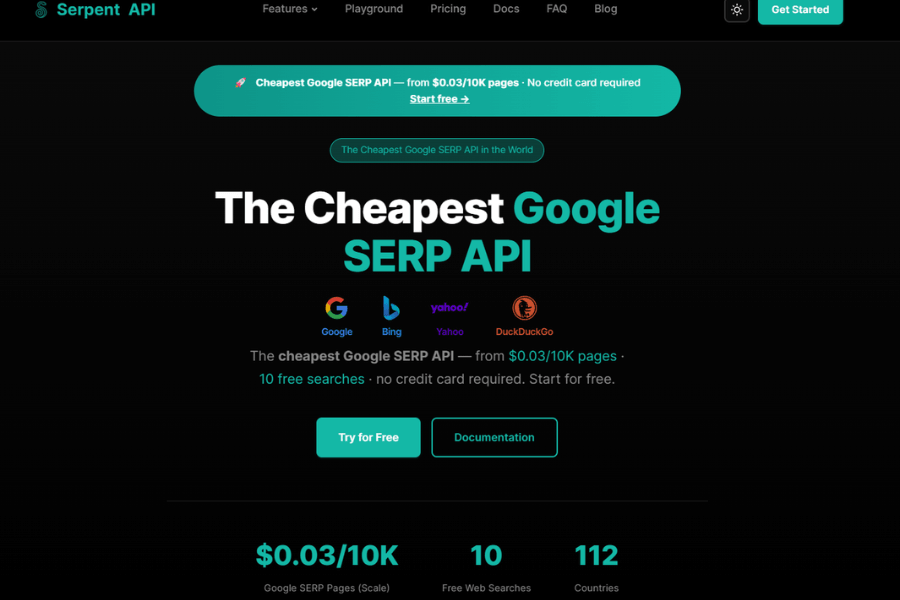
Serpent API’s Scale tier offers the lowest published rate for a managed SERP API: $0.03 per 1,000 pages with a one-time $500 deposit. Credits never expire.
By comparison, with all vendor pricing pages re-checked August 12, 2026: SerpApi subscriptions work out to $9-$25 per 1,000 searches, Serper.dev about $1 per 1,000 prepaid, DataForSEO $0.60 per 1,000 standard-queue SERPs, Bright Data $1.50 per 1,000.
At $0.03/1K, Serpent’s Scale tier undercuts every other managed SERP API in the market on a per-call basis.
What Serpent API covers:
- 5 search engines in one key: Google, Bing, Yahoo, DuckDuckGo, Brave
- Google Shopping PLAs included in SERP responses at no extra charge
- AI Overviews with full sources array
- Featured Snippets, PAA, Related Searches in every response
- Pixel position geometry (unique in the market — x, y coordinates for every SERP element)
- Local SERP targeting via country + city + ZIP code parameters
- YouTube, Instagram, LinkedIn data (social media endpoints)
- Google Maps (place search + reviews)
- AI citation tracking — ChatGPT, Claude, Gemini, Perplexity on one key
The three pricing tiers:
| Tier | Rate | Requirement |
|---|---|---|
| Default | $0.60/1K | No deposit needed |
| Growth | $0.06/1K | One-time $100 deposit |
| Scale | $0.03/1K | One-time $500 deposit |
Credits never expire on any tier. The deposit is not a monthly fee — it is a one-time purchase that permanently unlocks a lower rate.
Code example — Google SERP in Python:
import requests

def serpent_search(query: str, engine: str = "google", country: str = "us") -> dict:
    resp = requests.get(
        "https://apiserpent.com/api/search",
        params={
            "q": query,
            "engine": engine,    # google | bing | yahoo | duckduckgo | brave
            "country": country,
            "num": 10
        },
        headers={"X-API-Key": "YOUR_SERPENT_KEY"},
        timeout=15
    )
    return resp.json()

data = serpent_search("best seo audit tool 2026")

# Organic results
for r in data.get("organic_results", []):
    print(f"#{r['position']}: {r['title']}")
    print(f"  {r['url']}")

# AI Overview sources (if present)
aio = data.get("ai_overview")
if aio:
    print(f"\nAI Overview — {len(aio.get('sources', []))} sources cited:")
    for src in aio.get("sources", [])[:3]:
        print(f"  {src.get('url')}")

# Featured Snippet
if data.get("featured_snippet"):
    print(f"\nFeatured Snippet: {data['featured_snippet'].get('source_url')}")
Auto-refunds on server failures: When a request fails due to a server-side error (not a bad request from you), the credit is automatically returned to your balance. No support ticket needed. This matters at scale.
Best for: Rank trackers, SEO dashboards, competitive intelligence tools, agency tools managing multiple client campaigns, anyone building a production SEO SaaS where data cost is a primary concern.
Free trial: 10 calls, no credit card, never expire. apiserpent.com
DataForSEO — The Most Comprehensive SEO Data API
DataForSEO is the industry-standard choice for developers who need more than SERP results. It covers keyword data, backlink data, on-page crawling, and AI search visibility in addition to SERP scraping — all from one API.
DataForSEO’s SERP API costs $0.0006 per SERP ($0.60 per 1,000) on the Standard queue, $0.0012 ($1.20 per 1,000) on Priority, and $0.002 ($2.00 per 1,000) via Live mode, with a $50 minimum deposit.
The three DataForSEO delivery modes explained:
Standard queue ($0.60/1K): You submit a batch of queries. Results come back asynchronously — sometimes in minutes, sometimes longer depending on load. Cheapest option. Not suitable for real-time rank tracking where you need results immediately.
Priority queue ($1.20/1K): Faster queue processing. Between Standard and Live speed. Good for near-real-time workloads.
Live mode ($2.00/1K): Results return synchronously in 2-10 seconds, like a traditional API call. This is what you use if you need immediate results. With AI Overview parsing: $4/1K.
Our actual DataForSEO expenses, June 24 to July 24, 2026: $578.92 to power DataWise for 620+ users, spread across the SERP, Labs, Keywords Data and AI Optimization APIs. What that number tells you: if you are leaving DataForSEO because of price, you are probably leaving the cheapest option on the market for comprehensive SEO data.
The keyword volume endpoint:
This is DataForSEO’s most differentiating feature versus pure SERP APIs. You can pull monthly search volume, CPC, and competition data for thousands of keywords in a single task — sourced from Google Ads data.
import requests

# DataForSEO keyword volume lookup
resp = requests.post(
    "https://api.dataforseo.com/v3/keywords_data/google_ads/search_volume/live",
    auth=("your@email.com", "your_password"),
    json=[{
        "location_name": "United States",
        "language_name": "English",
        "keywords": [
            "seo audit tool",
            "rank tracker software",
            "keyword research tool",
            "backlink checker",
        ]
    }]
)

for task in resp.json().get("tasks", []):
    for item in task.get("result", []):
        print(f"{item['keyword']}: {item['search_volume']:,}/month | CPC: ${item['cpc']}")
What DataForSEO covers:
- SERP data (Google, Bing, Yahoo, and more)
- Keyword search volume (from Google Ads data)
- Keyword suggestions and related terms
- Backlink data
- On-page crawling and auditing
- AI search visibility (AI Overviews, AI Mode tracking)
- Content analysis
DataForSEO has an MCP server integration that lets you query SEO data directly from Claude or ChatGPT, which makes it genuinely useful for AI agent workflows in 2026.
The learning curve: DataForSEO’s API is more complex than simpler alternatives. The task-based async model requires a different architecture than a simple GET request. For developers new to APIs, there is a meaningful ramp-up period.
Best for: SEO platforms that need keyword volume + SERP + backlink data all from one provider. Agencies running bulk, asynchronous keyword research. Teams with technical resources who can handle the API complexity.
Free to start: $1 free credit on signup, $50 minimum deposit. No monthly subscription. dataforseo.com
Scrapingdog — Budget Option for Google-Only SERP
Scrapingdog positions itself as a low-cost Google SERP API with one of the fastest response times in published benchmarks.
Serper performed well in terms of speed and offered competitive pricing. Scrapingdog starts at just $0.001 per API call, becoming even more affordable at scale, dropping below $0.000058 per call, making it ideal for high-volume use cases. Independent testing clocked Scrapingdog’s search endpoint at roughly 1.83-2.52 seconds average.
By headline price alone, generic scrape/credit resellers like Scrapingdog (~$0.26/1,000) and DataForSEO’s queued Standard tier ($0.60/1,000) are the cheapest options in comparison.
What Scrapingdog covers:
- 17+ Google APIs (web, news, images, maps, shopping, scholar, jobs, autocomplete)
- AI Overview and AI Mode support
- JavaScript rendering
- Relatively fast response times (1.83-2.52 seconds)
- 200 free credits on signup, no card required
The main limitation: Google only. No Bing, Yahoo, DuckDuckGo, or Brave support.
Best for: High-volume Google-only workloads where response speed matters and multi-engine support is not required.
Serper.dev — Clean, Fast, Google-Only
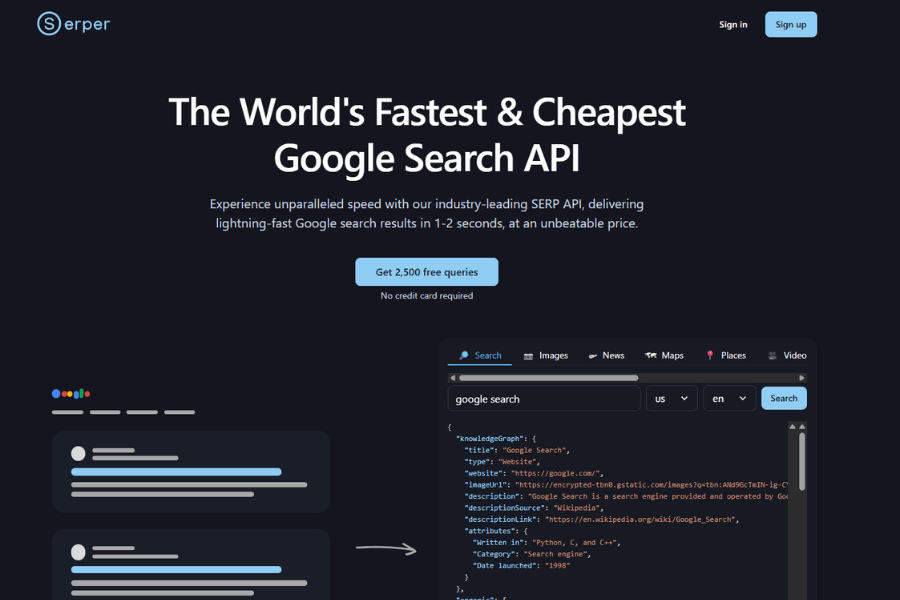
Serper.dev has been popular among developers since launch for being simple, well-documented, and fast.
Serper.dev has positioned itself as a faster, simpler alternative to SerpAPI, returning actual Google organic results with a clean JSON response. Pricing is approximately $1 per 1,000 searches at the minimum $50 prepaid pack, dropping to $0.30 per 1,000 on the largest bundle. Purchased credits expire six months after purchase. Requesting more than 10 results per query costs two credits, doubling the effective rate for deep result sets.
Scrapingdog benchmarks as one of the fastest SERP APIs with ~1.83 second average. Serper is in a similar speed range at roughly 1.8-2.9 seconds across endpoints. The per-credit cost drops from $1.00/1K at Starter to $0.30/1K at Ultimate with 2,500 free credits as the most generous free tier in the comparison.
One important caveat: Credits expire in 6 months. If you buy a large credit pack and do not use it fully, the remainder is lost. This is a real hidden cost for variable workloads.
What Serper covers: Google organic, news, images, scholar, maps, jobs, autocomplete, shopping. Google only — no Bing or other engines.
Best for: Developers who need Google-only data with fast response times and straightforward integration. Good for AI agents that fire off quick, single-engine lookups.
SearXNG — Open Source Metasearch (Self-Hosted)
Already covered above. SearXNG is genuinely free but requires self-hosting. Worth listing separately because for teams with infrastructure already in place, it eliminates search data costs entirely.
SearXNG is a free internet metasearch engine which aggregates results from up to 269 search services. Users are neither tracked nor profiled. Additionally, SearXNG can be used over Tor for online anonymity.
For a small VPS at $5-10/month, you can run a SearXNG instance that handles low-to-medium volume search queries with zero per-call cost. The trade-off is reliability and the absence of structured SEO-specific parsing (no featured snippets object, no AI Overview object — just raw search results).
Brave Search API — Independent Index, AI-Ready
Brave Search runs its own web crawler and index — it is not built on top of Bing or Google’s data. This makes it one of the only truly independent search indexes available to developers.
After Microsoft shut down the Bing Search API in 2025, Brave remained the only large independent western search index available to developers. In February 2026, the free plan (5,000 queries per month) was removed without warning. New users now get $5 in credits upon registration. A credit card is linked immediately.
Pricing: $5 per 1,000 requests (Search endpoint), $4 per 1,000 (Answers endpoint).
An independent August 2026 benchmark put Brave narrowly at the top on answer quality, with Exa, Firecrawl and Parallel’s Pro tier close enough that the gaps could be noise.
What makes Brave different:
The independent index means Brave results can differ meaningfully from Google results — especially for privacy-sensitive, tech, and developer queries. For AI agents that need search diversity and index independence, Brave is worth the cost premium over cheaper Google-based alternatives.
The pricing transparency advantage: A flat $5 per thousand calls. No per-result arithmetic. The only one of the four where you can predict next month’s bill from this month’s request count without a spreadsheet.
Best for: AI agents needing index independence from Google. Applications where Bing’s data (which was lost after August 2025) was being used for diverse search perspectives.
Exa — Semantic Search API
Exa is different from every other API in this list. It uses a neural index — meaning it understands query semantics rather than matching keywords.
Exa prices at $7 per 1,000 searches and folds the page contents for the first ten results into that price. Past ten results you pay $1 per thousand for each extra. Its neural index is built for “find documents similar to this” queries, with up to 1,200 domain filters and strong performance on conceptual similarity.
“Startups building AI tools for doctors” is an Exa query that works. Exa finds health-tech companies even if their pages do not contain those exact words.
What this means for SEO tools: Exa is not the right choice for traditional rank tracking (it does not return Google’s organic ranking order). It is valuable for content research tools, similarity-based competitor discovery, and AI agents that need conceptual retrieval rather than keyword matching.
Exa delivered the fastest responses at 1.180 seconds with semantic search over a proprietary index at $5 per 1,000 queries.(Note: the price has since increased to $7/1K.)
Best for: Content research tools, AI agents doing research and summarisation, tools that need “find similar pages to this” capability.
Tavily — Search API Designed for LLMs
Tavily is purpose-built for feeding clean, ranked web results into LLM context windows.
Tavily uses a credit system. The Pay-As-You-Go rate is $0.008 per credit, roughly $8 per 1,000. Monthly plans land between $0.005 and $0.0075 per credit, with the entry-level Bootstrap plan at $100 per month for 15,000 credits.
If you need AI-optimized search results that feed directly into agent context without additional formatting, especially if you are already using LangChain, Tavily is closer to plug-and-play than most alternatives.
Nebius acquired Tavily in February 2026 for a reported $275 million, which raises open questions about pricing stability and data handling under new ownership.
Best for: AI agents built on LangChain, LlamaIndex, or other LLM frameworks where you want search results that plug directly into prompts without post-processing.
SerpAPI — Widest Engine Coverage, Highest Cost
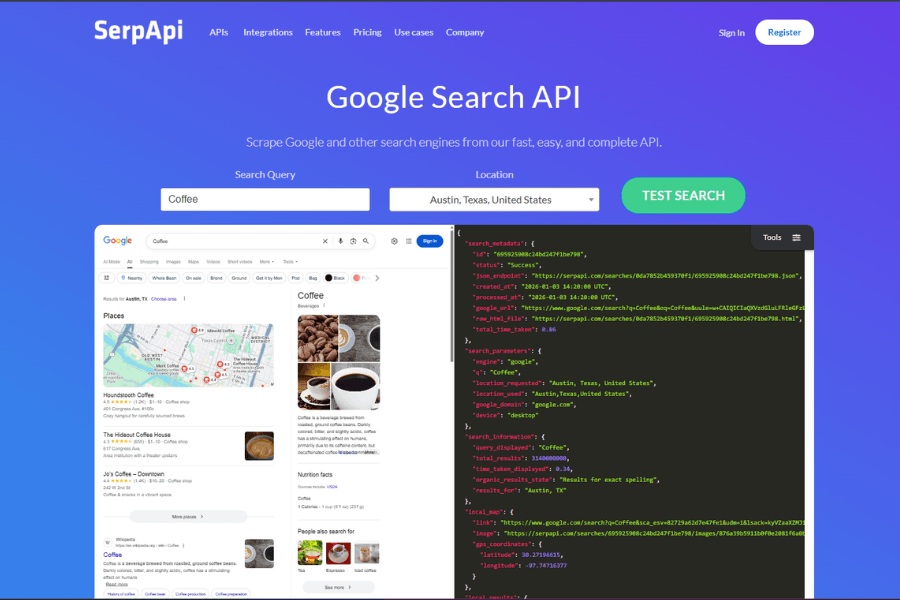
SerpAPI is the oldest and most established name in the SERP API market. It covers more search engines than any other provider — including Yelp, Walmart, eBay, Baidu, Yandex, Apple App Store, and Google Maps.
SerpAPI is the fastest Google search scraper API with the highest variety of Google-related APIs. Documentation is clear. Response time: approximately 5.49 seconds for SERP, 3.25 seconds for Scholar, 4.50 seconds for News.
The pricing: SerpApi subscriptions work out to $9-$25 per 1,000 searches, verified August 12, 2026.
At this price point, SerpAPI makes sense for one specific use case: you need engines that no one else covers — Yelp results, Walmart product listings, App Store rankings, Baidu. For standard Google + Bing rank tracking, the cost premium is not justified when alternatives at 300x lower cost exist.
Best for: Enterprise tools that need long-tail engine coverage (Yelp, Walmart, Baidu, App Store). Not recommended for general rank tracking or cost-sensitive workloads.
The Real Cost at Different SEO Tool Scales
This is the number that most comparison articles skip. Here is what you actually pay per month at realistic production volumes.
Scenario: Rank tracking tool, 500 keywords, daily checks, Google + Bing
500 keywords × 2 engines × 30 days = 30,000 API calls/month
| Provider | Monthly cost |
|---|---|
| TinyFish (if applicable) | $0 (rate limit applies) |
| SearXNG (self-hosted) | $5-10 (server cost only) |
| Serpent API (Scale) | $0.90 |
| DataForSEO (Standard queue) | $18.00 |
| Scrapingdog | $7.80 |
| Serper.dev | $30.00 |
| Brave Search API | $150.00 |
| SerpAPI | $275-725+ |
Scenario: SEO audit platform, 10 clients, 20 URLs each, weekly crawl, SERP + keyword volume
This requires both SERP data and keyword volume. Two APIs needed:
Option A: Serpent API (SERP) + DataForSEO (keywords)
- SERP: 10 clients × 20 keywords × 4 weeks = 800 calls at $0.03/1K = $0.024
- Keyword volume: 200 unique keywords at $0.05/1K = $0.01
- Total: approximately $0.04/month in raw data costs
Option B: DataForSEO only (covers both)
- SERP + keyword in one platform
- Estimated: $5-15/month for this volume
- Simpler integration, higher cost per call, broader data coverage
Scenario: AI agent with web search grounding, 50,000 queries/month
| Provider | Monthly cost | Index type |
|---|---|---|
| TinyFish | $0 (if 30 req/min is sufficient) | Aggregated |
| Serper.dev | $50 | |
| Brave Search | $250 | Independent |
| Exa | $350 | Neural |
| Tavily | $400 | LLM-optimised |
Hidden Costs: What the Pricing Tables Don’t Show
Credit expiry. Serper.dev credits expire after 6 months. If you buy 500,000 credits in January and use 300,000, you lose 200,000 credits. At $1/1K, that is $200 gone. Serpent API and DataForSEO credits never expire.
Per-result pricing multipliers. Some providers charge per result, not per query. Scrapingdog charges 2 credits for queries requesting more than 10 results, which doubles your effective cost if your tool needs 20+ results per search. DataForSEO bills per 10 results since Google’s num=100 parameter was removed — a 100-result query counts as 10 SERPs at $0.0006 each.
AI Overview add-ons. Several providers charge a separate fee for parsing the AI-generated answer block. Without it, you get the 10 blue links from 2022, not the SERP your users actually see. DataForSEO’s Live mode with AI Overview parsing costs $4/1K instead of $2/1K. Serpent API includes AI Overviews in the standard response at no extra charge.
Browser rendering surcharges. Static HTML scraping is cheap but breaks on AI Overview, People Also Ask, and other dynamic SERP elements. Browser rendering typically adds a 2-5x multiplier on top of the base rate.
Minimum monthly commitments. SerpAPI requires a minimum monthly plan ($25-$499+). Serper.dev has no minimum but credits expire. Serpent API and DataForSEO have no monthly minimum — you pay only for what you use.
Support-tier costs. SerpAPI offers 24/7 support on all plans. Serper.dev is email-only. DataForSEO has responsive support documented on G2. Serpent API covers email support at Growth tier and dedicated support at Scale.
How to Choose: A Decision Framework
Start here: What data does your tool actually need?
If your answer is “Google organic results + position tracking only”: Start with Serpent API’s Default tier ($0.60/1K, no deposit). Test data quality. Upgrade to Scale if you stay.
If your answer is “Google + Bing + Yahoo + other engines”: Serpent API covers 5 engines on one key. Same cost per call across all engines.
If your answer is “SERP + keyword volume + backlinks in one API”: DataForSEO. It is the only provider that covers all three meaningfully at developer-accessible pricing.
If your answer is “I am building an AI agent and need web search as context”: Start with TinyFish (free, 30 req/min). If volume exceeds that, evaluate Brave ($5/1K) or Serper.dev ($1/1K) depending on whether index independence matters.
If your answer is “I want semantic/neural search for content research”: Exa.
If your answer is “I want everything self-hosted, no invoices”: SearXNG. Accept the operational overhead.
The volume test:
Under 10,000 queries/month: Almost any option works economically. Optimise for integration simplicity and feature coverage.
10,000-100,000 queries/month: Cost starts to matter. Serpent API’s Growth tier ($0.06/1K, $100 deposit) gives you 10x savings over Serper without sacrificing quality.
Over 100,000 queries/month: Cost is your primary constraint. Serpent API Scale ($0.03/1K) or DataForSEO Standard queue ($0.60/1K for async batch) are the right choices. Every dollar per 1K adds up to thousands per year.
Frequently Asked Questions
For purely free: TinyFish Search (free with 30 req/min rate limit) or self-hosted SearXNG (free, you pay server costs). For managed SERP APIs with production reliability: Serpent API at $0.03/1K pages (Scale tier, $500 deposit). For comprehensive SEO data (SERP + keywords + backlinks): DataForSEO at $0.60/1K (Standard async queue).
Not by per-call rate. DataForSEO’s standard queue at $0.60/1K is more expensive than Serpent API’s Scale tier at $0.03/1K. However, DataForSEO bundles keyword volume, backlinks, and more — making it cheapest if you need multiple data types from one provider. For pure SERP data, Serpent API is cheaper.
Yes. Most SERP APIs including Serpent API support autocomplete queries. Pass type=suggest in the request parameters to get the dropdown suggestions Google shows as you type.
Microsoft retired the Bing Search API on August 11, 2025. Any tool built on the official Bing API stopped working on that date. Developers needed to migrate to alternative search APIs — most commonly Brave Search API (which runs an independent index) or SERP APIs like Serpent that cover Bing via scraping.
Usually yes. SERP APIs return live search results and rankings. Keyword data APIs return historical search volume, CPC, and competition scores. DataForSEO covers both. Otherwise, a typical setup pairs a SERP API (for rankings) with DataForSEO’s keyword endpoints (for volume data).
For a rank tracking SaaS that will serve paying users, the combination that works best is Serpent API (for live SERP data) at $0.03/1K at Scale tier, paired with DataForSEO’s keyword endpoints for search volume. Total data cost for a 50-user rank tracker checking 100 keywords daily: approximately $4.50/month. That leaves substantial margin at any price point.
Which API for Which Use Case
| Use case | Best pick | Reason |
|---|---|---|
| Cheapest managed SERP API | Serpent API | $0.03/1K, 5 engines, never-expiring credits |
| Free web search for AI agents | TinyFish | Free, fast, structured JSON, 30 req/min |
| Free, self-hosted, no invoices | SearXNG | Open source, full control |
| SERP + keyword + backlink data | DataForSEO | Widest data coverage, $50 min deposit |
| Google-only, fastest response | Serper.dev | 1.8s response, 2,500 free credits |
| Independent index (not Google/Bing) | Brave Search API | Own crawler, $5/1K |
| Semantic/neural search | Exa | Neural index, $7/1K with page content |
| LLM-optimised results | Tavily | Built for LangChain/agent workflows |
| Maximum engine coverage (Yelp, App Store) | SerpAPI | 80+ engines, highest cost |
All pricing verified from provider websites as of September 2026. Prices in the SEO API market change frequently — always check the provider’s current pricing page before depositing or committing to a plan.