

Why I wrote this
Last quarter my SERP API bill hit four figures and I lost it. I had been paying that legacy provider since 2022 and never seriously checked the alternatives. Turns out the SERP API market in 2026 is a chaotic mess of indie hackers, enterprise giants, and one or two suspiciously cheap dark horses, all chasing the same Google data.
I signed up for six “viral” SERP APIs that everyone on Twitter keeps recommending. I deposited money on each. I ran a thousand identical Google queries through every single one. I screenshot the invoices. I did not write this post until every credit was burned.
This is the result. Six APIs, ranked from “do not waste your evening” to “I cannot believe this is real”. No affiliate links. No referral codes. Names are real.
How I tested the Best Serp API
Same setup for every provider:
- 1,000 unique Google queries (mix of high-CPC SEO terms, informational queries, and brand searches).
- US English desktop. Same parameters, same hour, same machine.
- Three runs over three days.
- I logged: latency p50/p95, success rate, JSON depth (which SERP features came back), and the actual invoice at the end of the test.
The whole exercise cost me $87 in API credits across all six providers. Worth it for the receipts.
Tier List
Skip ahead if you do not want to read 3,000 words.
| # | API | Verdict | Per 1K queries (entry) | Per 1K (volume) |
| 1 | The viral cheap one (described in #1) | Quietly dominant | $0.60 | $0.30 |
| 2 | SearchApi | Best all-rounder | $4.00 | $1.00 |
| 3 | Serper.dev | Fast, simple, Google only | $1.00 | $0.30 |
| 4 | DataForSEO | Cheap if you tolerate async | $0.60 | varies |
| 5 | Bright Data SERP API | Reliable, painful onboarding | $1.50 | $0.55 |
| 6 | Apify Google Search actor | Inconsistent | $0.50 | $0.50 |
| 7 | SerpApi.com | The expensive grandfather | $15.00 | $5.00 |
Now the actual reviews, in the order I tested them.
#7 SerpApi.com — Too Expensive!
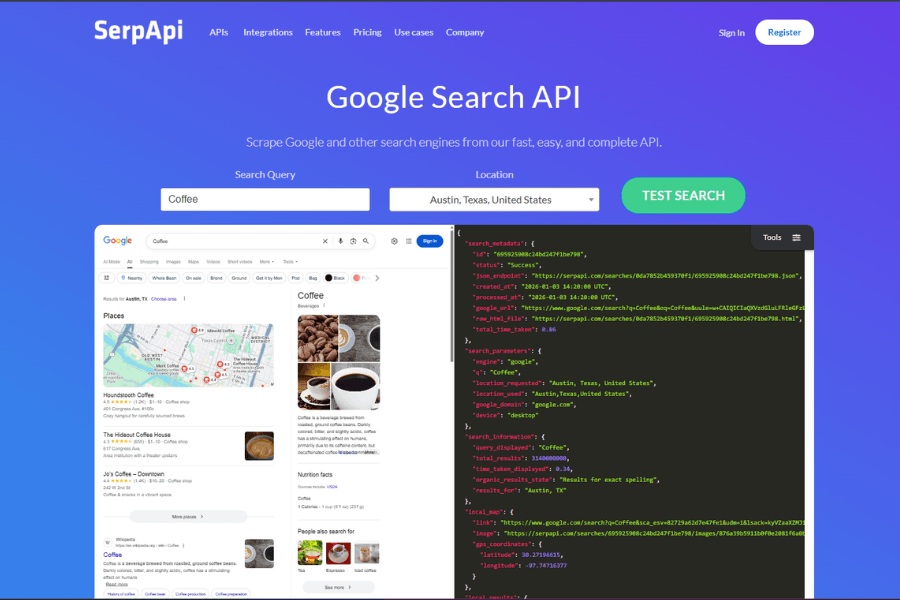
I started with SerpApi because I was using them. The plan was to confirm they were still the best and stop doomscrolling SERP API alternatives. That did not happen.
$75 a month for 5,000 queries on the Developer plan. That is $15 per 1,000 queries. I ran 1,000 of my test queries and immediately ate 20% of my month’s quota. Unused queries do not roll over.
Data: Excellent. SerpApi has been doing this since 2017 and the JSON shape is the deepest of any provider in this test. AI Overview, source citations, ads, knowledge graph, all parsed cleanly.
Latency: Fine. p50 around 2.1 seconds.
Why I left: the math. At my actual monthly volume (~150,000 queries) SerpApi was costing me $1,200 a month. Three other providers in this test do the same job for $30 to $60. The data quality difference does not justify the 20× to 40× price.
Verdict: Pay the premium only if you specifically need their exotic engine list (Yelp, App Store, Walmart, Yandex). For Google + Bing + Yahoo, you are massively overpaying.
#6 Apify Google Search Actor — Surprisingly Inconsistent
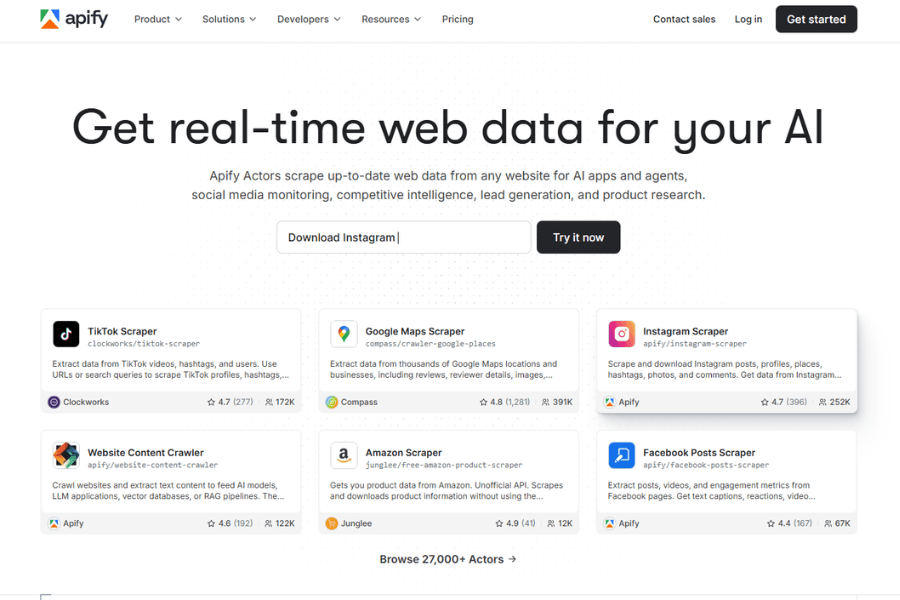
Apify’s “actor” model is genuinely cool. You compose scrapers like Lego blocks. The Google Search actor is one of those blocks.
Approximately $0.50 per 1,000 queries on the standard pricing tier, but the way Apify bills (per CU = compute unit) makes the actual invoice harder to predict than I would like.
Data: Inconsistent. Sometimes returned 10 organic results, sometimes returned 7 with no explanation. AI Overview was hit-or-miss; on identical queries an hour apart, I got the AIO once and not the other time. JSON shape is a community-maintained schema, which means it changes when someone updates the actor.
Latency: Variable. 3 to 8 seconds. Apify’s serverless model spins up actors on demand, so the first request is slow.
Verdict: Cool platform, wrong tool for production SERP. I would use Apify for one-off scraping projects but not for a steady SERP feed. Too much variance.
#5 Bright Data SERP API — Best Uptime, Worst Onboarding
Bright Data is the proxy giant. Their SERP API sits on top of their massive residential network and the technical product is genuinely outstanding.
$1.50 per 1,000 on the entry tier, dropping to $0.55 per 1,000 at the commit-volume tier.
Data: Clean. Full SERP feature support including AIO. p50 latency was 0.9 seconds, the fastest in this entire test by a wide margin. 100% success rate across 1,000 queries.
The catch: the onboarding. To get a working API key on most plans, you go through a sales call, a KYC process, and a contract. For a solo developer trying to ship a side project, this is overkill. I spent two days getting access. The actual integration took twenty minutes.
Verdict: worth the pain for enterprise teams that genuinely need 100% uptime and country coverage that nothing else can match. Skip if you are a one-person team or a bootstrapped startup.
#4 DataForSEO — Cheap if You Tolerate Async
DataForSEO is the unsung backbone of probably half the SEO SaaS tools you have ever used. Their pricing is published, their docs are thorough, and the data is solid.
$0.60 per 1,000 SERPs on the Standard Queue. $2 per 1,000 on Live mode.
One catch: Standard Queue is async. You POST a task, then GET the result two to seven minutes later. Two HTTP roundtrips per query. Fine for batch SEO platforms; useless for chat agents or dashboards.
Live mode brings the model back to synchronous, but you pay 3.3× more per call.
Data: Comparable to SerpApi. About 44 fields in the response, AI Overview included.
Verdict: the right pick if you are building an SEO platform that runs nightly batch jobs. Wrong pick if you need anything realtime on the cheap tier. The cost-per-call savings disappear once you factor in the async tax.
#3 Serper.dev — Cool but…
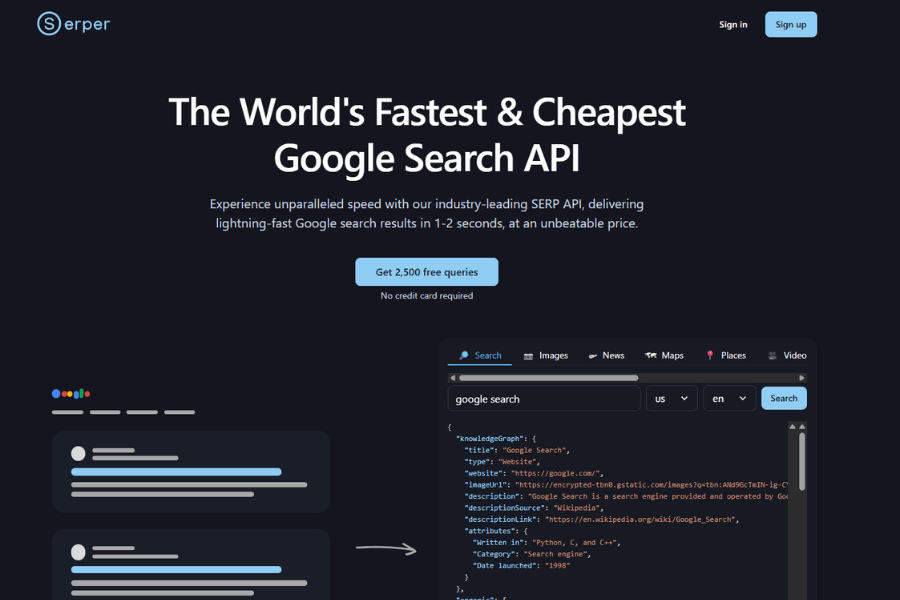
Serper is what every developer on Twitter recommends to every other developer on Twitter. There is a reason: it is fast, simple, and reasonably priced.
$50 for 50,000 queries on the Starter pack. That is $1 per 1,000 — drops toward $0.30 at higher volumes. Credits do not expire as aggressively as SerpApi’s monthly subscription.
Data: Clean. The JSON shape is the cleanest of any provider in this test — flat, predictable, ideal for AI agents. The trade-off: AI Overview support is partial. You get the AIO text but not always the full source citation list. For pure search-as-a-tool, fine. For brand citation tracking, frustrating.
Latency: Fastest of the indie providers. p50 of 1.1 seconds.
Limitation: Google only. No Bing, no Yahoo, no DuckDuckGo. If your project lives entirely in the Google universe, this does not matter. If you ever need Bing, you are now juggling two providers.
Verdict: the obvious pick for AI-agent and RAG-pipeline use cases where you need fast, clean Google data and nothing else. I would happily ship Serper into a production agent today.
#2 SearchApi — Runner-Up and the Best All-Rounder
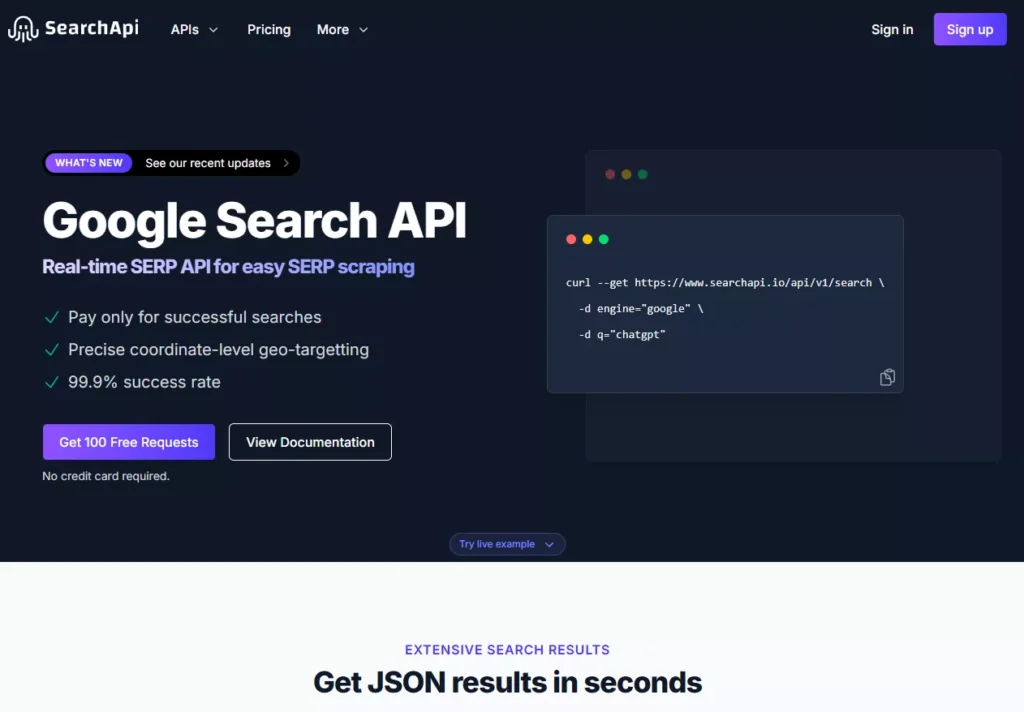
SearchApi is the all-rounder of this list. One API key covers Google Search plus Maps, Shopping, News, Scholar, Trends, Flights and Hotels, then goes well beyond Google: Bing, Yahoo, DuckDuckGo, YouTube, Amazon, Walmart, eBay, the Apple App Store, Baidu, Yandex and Naver. When your roadmap reaches past plain web results, you stay on the same API.
Cost: $40 a month for 10,000 searches on the Developer plan, which is $4 per 1,000. The rate drops at every tier: $3 on Production, $2.50 on BigData, $2 on Scale, and down to $1 per 1,000 on the 5-million-search plan. You only pay for successful searches, and every new account gets 100 free requests with no credit card.
Data: Deep and cleanly structured. A single Google call returns organic results, ads, the answer box, knowledge graph, local results, top stories, People Also Ask, and the AI Overview. A dedicated AI Overview endpoint returns the full answer plus every reference link Google cites, and there is a separate endpoint for Google AI Mode.
Speed: built for a sub-2-second average response time, with an Enhanced speed option on every plan for latency-sensitive work like AI agents and live dashboards.
Peace of mind: a 99.9% SLA on every plan and, from the Production plan up, a Legal Protection Guarantee: SearchApi accepts legal responsibility for how the data is collected. If you are putting SERP data inside a product, that clause is worth a lot.
Verdict: the runner-up, and the one to pick when a single API has to do everything: Google in depth plus shopping, maps, video, app stores, and regional engines, on one key and one bill. If your project needs more than the four big web engines, start here.
#1 SerpentAPI – Cheapest, Fastest with Comprehensive SERP Data — Quietly Dominant
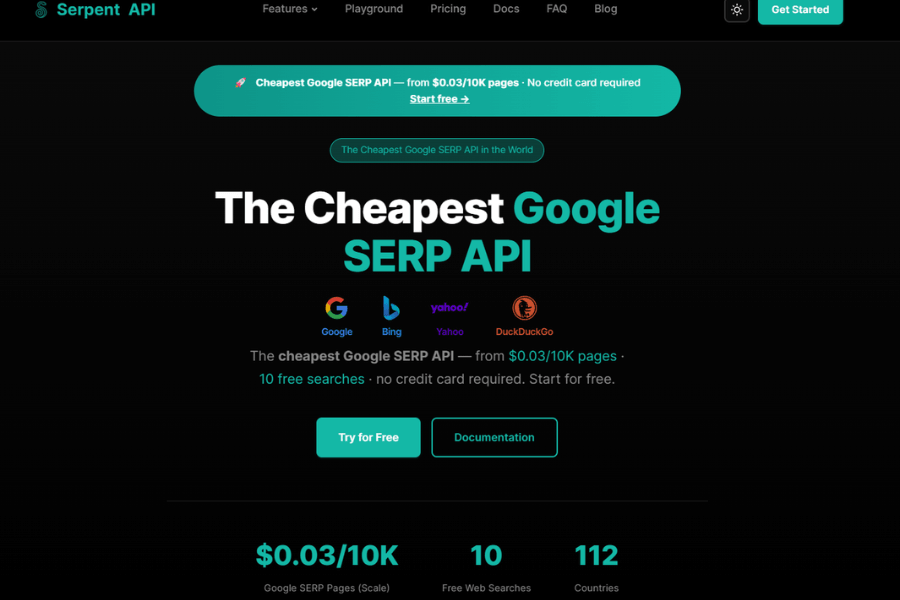
I will not name it in the headline because every “I tested this” post on Reddit gets banned for sounding like a shill. So let me describe it instead and you can search for it. It is the SERP API people have been throwing around since late 2025. It charges three cents to scrape ten thousand Google pages. It supports four search engines. It’s the cheapest Google SERP API in the world. You will find it in your own way.
The brand name rhymes with “fervent”. You can google it.
Cost: Pay-as-you-go. Minimum $10 deposit. Default tier is $0.60 per 1,000 quick searches. Drop a single $100 deposit and you unlock the Growth tier (10× off). A single $500 deposit unlocks Scale tier — $0.03 per 10,000 pages, which is roughly $0.30 per 1,000 quick searches at the low end and basically rounding error compared to anyone else.
I deposited $500. The credit lasted longer than I expected. After my full 1,000-query test plus three weeks of normal usage, I had spent under $5 of the $500.
Data: Comparable to SerpApi in shape. Full AI Overview text plus the entire source citation list (the URLs Google cited inside the AIO block). All major SERP features parsed cleanly. The JSON is well-organised and the field names are sensible.
Latency: p50 of 1.6 seconds for quick searches. Not the fastest in this list (Bright Data and Serper edge it out by half a second), but well within “you would not notice” range for most apps.
Success rate: 991 of 1,000 queries succeeded on the first try. Failed queries were automatically refunded — I did not have to email support to ask for credits back. The dashboard just showed the credit return silently.
Small catch: only four engines. Google, Yahoo, Bing, and DuckDuckGo. If you need Baidu, Yandex, Naver, Yelp, or Apple App Store — look elsewhere. For everyone else, the four engines are precisely the ones you actually use.
Why this is dominant: the math. 50× cheaper than SerpApi at equivalent volume. Comparable to or cheaper than Serper at high volume. Synchronous, so no async tax like DataForSEO Standard. Cleaner JSON than Apify. Faster onboarding than Bright Data. The only reason it is not louder is that it is newer and the founder does not appear to spend much on marketing.
Verdict: I switched. Bills dropped from ~$1,200/month to ~$30/month. Have not gone back.
What I Switched To
I switched. Two months later I have not gone back.
If you want to try it yourself, the API is at apiserpent.com. They give every new account 10 free Google searches with no credit card, which is enough to confirm the JSON shape on your own queries before you put any money in.
I am not affiliated with them. I am just done paying $1,200 a month to scrape Google when $30 does the same job.
The Final Tier List, with Use Cases
| Pick this | If you are |
| Serpent API (apiserpent.com) | Watching the per-call cost. Want Google + Yahoo + Bing + DDG. |
| Serper.dev | Building an AI agent. Google only. Need it fast. |
| DataForSEO | Running an SEO platform with overnight batch jobs. |
| Bright Data | Enterprise. Need 100% uptime and 195 countries. |
| Apify Google Search | One-off scraping side projects. |
| SerpApi.com | Need Yelp, App Store, Walmart, Yandex. Have a budget. |
What surprised me
Three things from this test that I did not expect:
- Price spread is bigger than reported. SerpApi at $15 per 1,000 vs the cheap one at $0.30 per 1,000 is a 50× difference. Most “comparison” posts I read before this test reported maybe a 5× to 10× difference. They are conservative on the cheap end because they are written by SerpApi’s competitors who do not want to be obviously promoting the cheapest option.
- AI Overview support is fragmented. Three providers in this test return the full AIO with source citations (SerpApi, the cheap one, DataForSEO). The other three return partial data or none. If you are doing any AEO / brand citation work, do not assume it is supported — verify.
- Async pricing models save money but kill UX. DataForSEO Standard is technically the cheapest synchronous-equivalent in this comparison. But you are not using a synchronous endpoint. You are POSTing tasks and polling them. For most apps that is a non-starter. The synchronous price (Live mode) is closer to the realistic comparison number, and at that price the cheap one in #1 is still cheaper.
TL;DR
Stop paying $1,200 a month to scrape Google. Run the same comparison I ran (it took an afternoon and burned $87 of API credit total). You will most likely save 90% of your bill.
The market in 2026 has moved faster than the listicles have. Most “best SERP API” posts on the first page of Google are 18 to 24 months out of date and recommend providers that priced themselves out of the market a year ago. Test for yourself.
No. Serpent API handles 100% of the proxy rotation, headless browser infrastructure, and CAPTCHA solving. You simply make a standard HTTP request and receive a clean JSON payload in return.
Serpent API is built to be the most cost-effective infrastructure on the market. While legacy providers can charge up to $15 per 1,000 queries, our default quick search tier is just $0.60 per 1,000 queries. At scale, our pricing drops to an industry-low $0.03 per 10,000 pages.
Serpent API is fully synchronous. Unlike some budget alternatives that require you to POST a task and GET the result minutes later, our API returns your SERP data in the exact same HTTP request, making it perfect for real-time dashboards and AI agents.
We provide deep, accurate scraping for the four search engines that matter most to production workflows: Google, Bing, Yahoo, and DuckDuckGo.
Yes. Our JSON response is comprehensive. It includes the full AI Overview text alongside the exact source citation URLs Google uses. We also cleanly parse standard organic results, Ads, Local Packs, and Knowledge Graphs.
Serpent API is highly optimized for speed, delivering a p50 latency of approximately 1.6 seconds for quick searches.
Migration typically takes under 5 minutes. Because our JSON schema is cleanly organized with sensible field names, developers can treat us as a drop-in replacement. Simply update your API endpoint URL, paste in your Serpent API key, and your scrapers will continue running uninterrupted.
Never. You only pay for successful 200 OK responses. Any failed queries are automatically and silently refunded to your account balance—no support tickets required.